

Regulating Artificial Intelligence in a Fragmented World — RegulatingAI Podcast

RegulatingAI Podcast
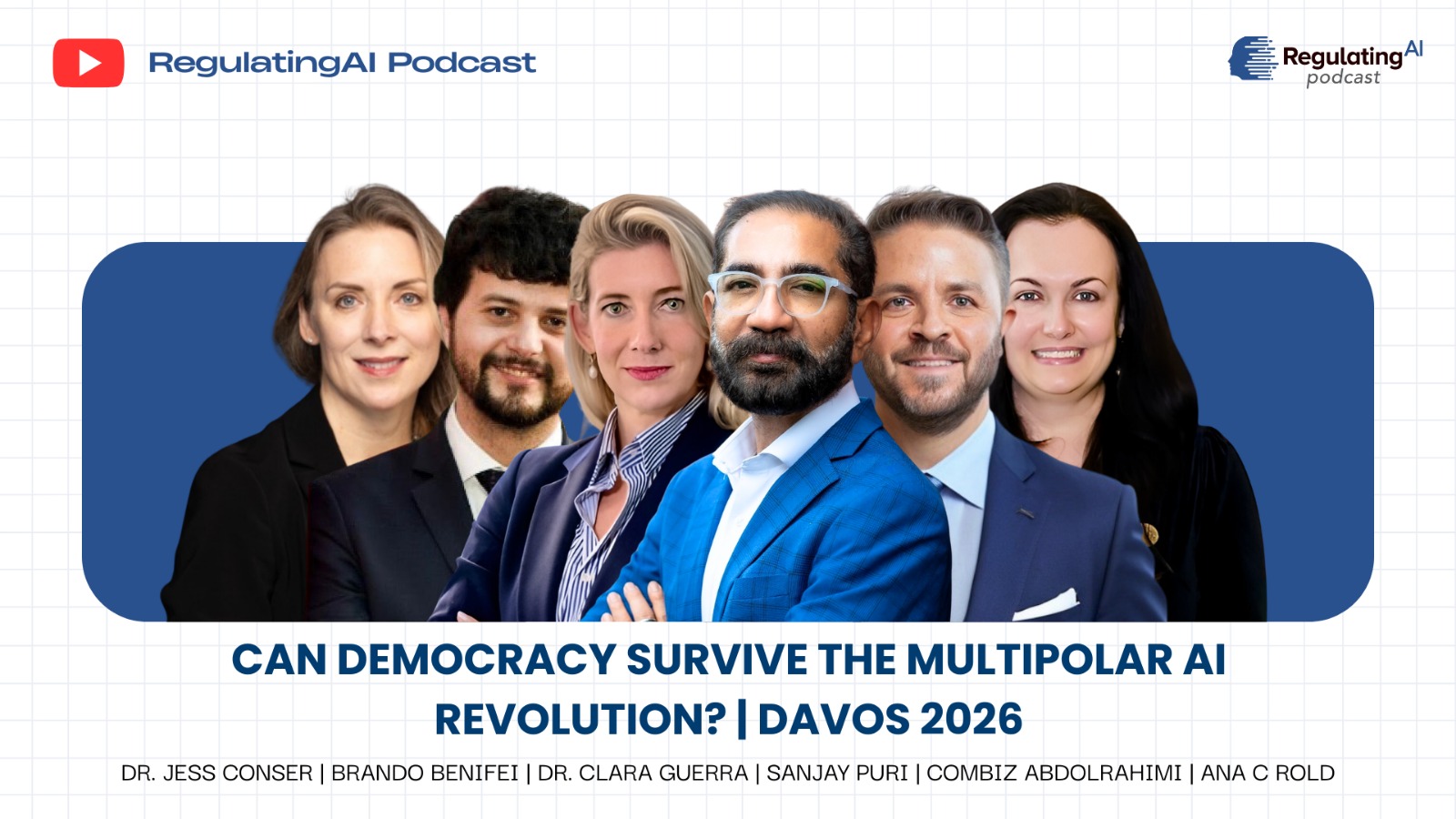
Global AI leaders with Sanjay Puri, Founder & President, Knowledge Networks
AI is reshaping democracy faster than rules can follow. Leaders on the Regulating AI podcast explore governance, coalitions, and the future of democratic AI.
Joining Sanjay Puri are Dr. Jess Coner, Chief AI Impact Officer at Imaginative.com; Brando Benifei, Member of the European Parliament and one of the architects of the EU AI Act; Kies Abraimi, Global Head of Government Affairs at ServiceNow; and Clara Neppel, a leading voice on AI governance and digital transformation from Liechtenstein.
Governance Is Everyone’s Business
From the outset, the Regulating AI podcast reframes governance as more than a bureaucratic exercise. As Sanjay Puri emphasizes, AI governance affects “societies and democracy,” not just institutions. The panel echoes this view, underscoring that diplomacy, policy, education, healthcare, and industry must all be part of the same conversation.
Clara Neppel captures this shift clearly: “Innovation, digitization, and emerging technology are not a one-off and not an IT project. It’s a cross-sector approach and an ongoing process.”
Fragmentation Happens in Practice, Not Principles
While geopolitical narratives often focus on value clashes, several guests argue that fragmentation rarely stems from disagreement on fundamentals. As one panelist notes, “We can often align on accountability, transparency, and human oversight. The break happens at the level of execution.”
Dr. Jess Coner offers a useful framework for understanding this gap, describing four zones of AI maturity—from hype and wasted opportunity to frustration and transformation. “Convergence is a journey,” she explains, “and literacy is the foundation that allows governance and diplomacy to scale.”
Coalitions of the Willing: A Practical Path Forward
Given the pace of AI development, waiting for universal consensus may not be realistic. Instead, the panel explores the idea of coalitions of the willing—groups of countries and organizations prepared to prototype governance models that others can adopt.
As one guest puts it, “AI governance is being copied when it works.” Drawing parallels to nuclear and aviation safety, the panel stresses that AI’s shared risks demand shared constraints, even across different political systems.
The EU AI Act and the Cost of Inaction
The conversation turns concrete with insights from Brando Benifei, who explains how the EU AI Act attempts to balance innovation with democratic safeguards. Certain uses of AI—such as mass biometric surveillance, emotion recognition in schools and workplaces, and AI-only predictive policing—are explicitly banned.
Benifei is blunt about the stakes: “We do not want AI-powered systems to trample the presumption of innocence or quietly compress democratic freedoms.” He also highlights challenges around deepfakes, transparency, and copyright, noting that regulation must remain flexible as technology evolves.
Small States, Big Influence—and the Role of Industry
Clara Neppel argues that smaller states can play an outsized role in AI governance by moving quickly and acting as neutral conveners. “Because we are not a threat to anyone and have no skin in the game, we can help showcase how governance models can work,” she reflects.
From the private sector perspective, Kies Abraimi reinforces the need for collaboration: “Corporations are profit-driven, governments are mission-driven. Governance is how we bring the two together.”
Governance as Navigation, Not Restriction
A powerful metaphor closes the episode. Governance, Dr. Jess Coner says, is not about restriction but responsiveness: “It’s about knowing when to slow down, when to go fast, and when to be more responsive.”
As this episode of the Regulating AI podcast makes clear, democratic AI is still within reach—but only if governance keeps pace, coalitions form where consensus can’t, and responsibility is shared across borders, sectors, and societies.
Upasana Das
Knowledge Networks
email us here
Visit us on social media:
LinkedIn
Instagram
Facebook
YouTube
X
Legal Disclaimer:
EIN Presswire provides this news content "as is" without warranty of any kind. We do not accept any responsibility or liability for the accuracy, content, images, videos, licenses, completeness, legality, or reliability of the information contained in this article. If you have any complaints or copyright issues related to this article, kindly contact the author above.
